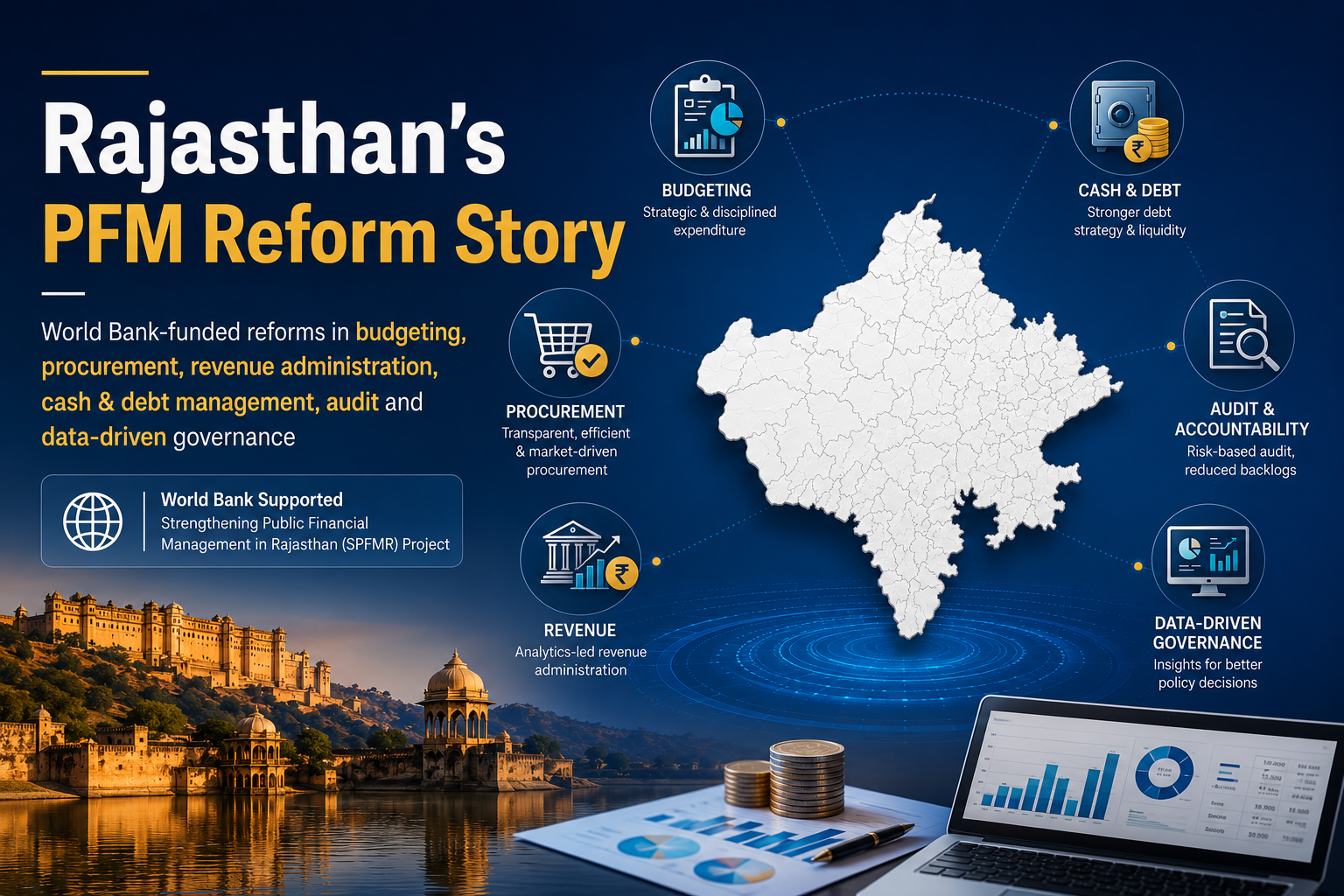
Public Financial Management reforms are often discussed in technical language—budget execution, cash management, procurement systems, audit backlogs, tax analytics, and fiscal reporting. But at their core, these reforms answer a simple governance question:
Can the State use public money more transparently, efficiently, and intelligently?
Rajasthan’s reform journey under the World Bank-funded “Strengthening Public Financial Management in Rajasthan” project (From FY 2018-2025) gives an important case study in this direction. Based on the Implementation Completion and Results Report of the project, Rajasthan undertook a multi-dimensional reform programme covering budgeting, procurement, revenue administration, cash and debt management, audit, institutional capacity, and decentralized planning.
The significance of this project lies reform architecture it supported. It helped Rajasthan move from fragmented manual processes toward integrated, technology-enabled, and data-driven public financial management systems.
1. Budget Reform: From Annual Spending to Strategic Expenditure Management
A major reform area was budget execution and expenditure management.
Traditionally, government budgeting often remains annual, input-based, and department-centric. Departments receive allocations, spend against budget heads, and report expenditure. But such a system does not always capture future liabilities, pending commitments, or the actual fiscal burden created by today’s decisions.
Rajasthan attempted to address this through the Commitment Control System, integrated with IFMS 3.0. This system was designed to track multi-year financial commitments in real time. It was piloted across 10 line departments and captured planned, actual, and discharged obligations for capital expenditure above specified thresholds.
This is important because many fiscal pressures arise not only from actual expenditure but from commitments already made. A government may appear fiscally comfortable in the present year, but future obligations can create stress if they are not tracked properly. Commitment control helps bring discipline before expenditure becomes unavoidable.
Another important intervention was scheme rationalization. Finance department reviewed 1,266 public schemes across 24 departments. Out of these, 119 redundant schemes were discontinued and 24 others were merged. Remaining schemes were classified into high, medium, and low priority streams.
This reform has a larger public finance meaning. Every scheme creates administrative cost, reporting burden, monitoring complexity, and fiscal rigidity. Scheme rationalization helps the State focus resources on priority interventions instead of spreading money thinly across too many schemes.
The project also supported a Public Investment Management framework. This framework introduced evaluation, readiness checks, lifecycle costing, climate-resilient public investment guidelines, and PPP-related configurations before capital projects enter the budget.
In simple terms, this means capital expenditure is not treated merely as a budget entry. It is examined as a long-term public investment decision.
2. Procurement Reform: Making Government Buying More Transparent and Efficient
Procurement is one of the most sensitive areas of public finance management. It directly affects cost, competition, transparency, and delivery quality.
Rajasthan’s reforms focused on reducing transaction costs, improving standardization, and increasing digital tendering.
A major step was the expansion of e-procurement through reduction of administrative thresholds. The report states that the total contract value processed through electronic tendering increased from around ₹23,000 crore in FY17 to over ₹268,876 crore in FY25.
This expansion matters because e-procurement reduces manual interface, improves visibility, and creates a stronger digital trail.
The Finance Department also developed and published five Standard Bidding Document models covering Supply & Installation, Swiss Challenge, PPP, Modified Annuity, and IT Equipment.
Adoption of Standard Bidding Documents reduce ambiguity, bring consistency across departments, and make procurement more predictable for bidders. For vendors, this reduces uncertainty. For officials, it reduces avoidable drafting errors and procedural disputes.
Another important reform was the creation of a centralized database of debarred entities. This supports vendor integrity by helping departments identify risky or debarred suppliers during procurement.
The report also mentions improvements in procurement cycle time. More than 93% of contracts were awarded within the initial bid validity window, compared to a baseline of 50%. Further, shifting tender notifications online reduced spending on physical newspaper advertisements from 0.41% to 0.11% of total tender values.
This shows that procurement reform had enabled speed, cost efficiency, and better market functioning.
3. Revenue Administration: From Subjective Selection to Data Analytics
One of the strongest components of PFM reform story is the modernization of revenue administration.
After the introduction of GST, states had to rethink tax administration. Rajasthan responded through business process reengineering and analytics-based enforcement.
In the Commercial Taxes Department, the State created the Business Intelligence Unit and Business Audit Wing. These units institutionalized data analytics for enforcement. The report also mentions the launch of India’s first subnational GST Audit Manual.
The reform moved tax administration away from subjective selection toward risk-based targeting. Analytics were used for Input Tax Credit outlier tracking and HSN-based sector anomalies. The report states that ITC outlier analytics alone helped identify over ₹3,000 crore in tax leakages.
The impact on audit targeting was significant. The tax audit hit-rate increased from a baseline of 10% to over 98%.
This is a major administrative shift. It shows that better data can improve enforcement without necessarily increasing arbitrary inspections. When audit selection is risk-based, departments can focus on cases where discrepancies are more likely.
The Commercial Taxes Department also undertook a major Demand Collection Register clean-up. Historical tax arrears and flawed entries were reduced from 1.18 million to around 40,000 entries.
This is important because unreliable arrear data weakens revenue planning. A clean demand register helps the department distinguish between collectible arrears, disputed amounts, and flawed legacy entries.
The Excise Department also introduced major digital reforms through IEMS 2.0. Licensing, risk-based evaluations, and automatic renewals were automated. The report also mentions blockchain-enabled track-and-trace systems, QR-coded secure labels, GPS-guided vehicle transit, digital locks, and CCTV warehouse monitoring.
In the Transport Department, over 90% of citizen and corporate services were moved to electronic platforms. Collections were routed through e-GRAS, integrated with treasury systems, and supported by automated electronic defacement.
4. Cash and Debt Management: Bringing Discipline to Borrowing Decisions
Cash and debt management are often invisible to ordinary citizens, but they are central to fiscal stability.
The report highlights the creation of an Integrated Cash and Debt Management System within IFMIS 3.0. This system unified financial records across different debt instruments and gave the State real-time visibility over liabilities, maturities, and cash balances.
This is important because fragmented debt records make it difficult to manage borrowing efficiently. A government needs to know not only how much it owes, but also when repayments are due, what cash is available, and how future borrowing should be scheduled.
Finance department also changed its borrowing cycle. Instead of relying on bulk borrowing at month-end, the State moved toward 2–3 calculated borrowing cycles per month based on rolling 30-day cash forecasts.
This reform is particularly meaningful because month-end cash stress often coincides with salary and pension payments. Better forecasting allows borrowing to be aligned with actual cash needs.
The State also adopted a Medium-Term Debt Strategy and published Debt Statistical Bulletins. The report states that the weighted average maturity of State Development Loans increased from around 10 years to over 13.5 years. It also states that the borrowing interest rate spread narrowed from 12 basis points above the national average in FY18 to nearly 1 basis point in FY25.
These changes indicate more disciplined debt management and reduced refinancing risk.
5. Audit and Accountability: Reducing Backlogs and Discretion
No public finance reform is complete without stronger accountability.
Rajasthan introduced Audit Management Software in the Local Fund Audit Department. This system covered the digital audit lifecycle across regional branches. It introduced system-driven random selection for unit allocation and audit party formation. It also used risk-based parameters such as budget size, past irregularities, and pending audit years.
This reform matters because audit systems are vulnerable to delay and discretion. If audits are delayed for years, accountability weakens. If audit selection is manual, there is always scope for inconsistency.
The report states that these reforms resulted in a 54% reduction in long-pending audit backlogs.
This is a governance gain. Timely audit improves the chance of timely correction.
6. Data for Policy Action: From Experience-Based Decisions to Evidence-Based Governance
Another important reform area was the use of data for policy decisions.
Rajasthan developed analytics frameworks such as the Welfare Scheme Participation Index, Prosperity Index, and subnational SDG Index. The note also mentions dashboards covering over 105,000 schools and real-time medical vital tracking through the Pehchan portal.
This reflects a shift from experience-based decision-making to evidence-based policy action.
The State also linked decentralized participatory planning with budget systems. Panchayati Raj Institution annual plans prepared through eGramSwaraj and GIS tools were linked with IFMIS 3.0 budget allocation modules.
This is significant because local plans often remain disconnected from actual budget allocation. A digital linkage between grassroots planning and financial systems can make decentralized planning more meaningful.
7. Building Reform Capacity: PFMTI and CoERRA
A reform programme cannot survive only on software, consultants, or project timelines. It needs permanent institutional capacity.
The report mentions the establishment of the Public Financial Management Training Institute as an autonomous training body. It also refers to the establishment of the Center of Excellence in Revenue Research and Analysis.
These institutions are important because reforms must be understood, used, and continuously improved by government officials. Training, analytics, audit protocols, and revenue research cannot remain one-time interventions. They must become embedded in the bureaucracy.
This institutionalization is perhaps one of the most important lessons of the World Bank-funded project.
The Larger Lesson from Rajasthan’s PFM Reform Journey
Rajasthan’s experience under the World Bank-funded Strengthening Public Financial Management in Rajasthan project shows that public finance reform is not a single reform. It is a chain.
A budget becomes credible when commitments are tracked.
Capital expenditure improves when projects are screened before inclusion.
Procurement becomes efficient when bidding documents are standardized and tendering is digital.
Revenue improves when analytics replaces subjective selection.
Debt becomes more sustainable when borrowing is linked to cash forecasting.
Audit becomes stronger when risk-based systems reduce discretion.
Planning becomes meaningful when local plans are linked with budget systems.
Institutional capacity becomes durable when training and analytics bodies are created.
The larger lesson is clear: technology can provide the architecture, but governance improves only when that architecture changes administrative behaviour.
The World Bank-funded project provided Rajasthan with a structured reform platform. But the long-term success of these reforms will depend on continuity, data quality, departmental ownership, and the seriousness with which these systems are used in day-to-day governance.
For Rajasthan, the direction of reform is clear: from fragmented systems to integrated platforms, from manual discretion to system-based controls, from post-facto reporting to real-time decision support, and from compliance-based public finance to data-driven governance.