For over two decades, the core philosophy of macroeconomic management in India has been guided by a singular mandate: enforce fiscal discipline through strict numerical caps. Enacted through the Fiscal Responsibility and Budget Management (FRBM) Act of 2003 at the national level and subsequent Fiscal Responsibility Legislations (FRLs) across various states, these boundaries were designed to eliminate the “deficit bias” of governments, curb inflation, and secure long-term debt sustainability.
However, an extensive empirical study by researchers Irsad, Mohd Yousuf Malik, and Syed Hasan Jafar evaluating India’s public finances from 1991 to 2022 exposes a deep structural flaw in this mechanism. The authors demonstrate an institutional “Decentralization Paradox”: while uniform fiscal rules successfully anchor stability at the national level, they create a restrictive trap that suppresses economic expansion at the sub-national (state) level.
Fortunately, India’s public finance policy is undergoing a massive structural evolution. By connecting the historical baseline of that academic paper with NITI Aayog’s Fiscal Health Index (FHI) 2026, the legislative overhauls of the 16th Finance Commission, and the operational funding of the Central Government’s SASCI Scheme, we can map out how India is successfully shifting from rigid containment to a flexible, growth-centric framework.
1. The Academic Diagnosis: The Simultaneous Model and the Capex Trap
To untangle how legislative rules affect different tiers of government, the authors built a comprehensive Fiscal Performance Index (FPI) using Principal Component Analysis. This index aggregates six distinct variables to capture both revenue mobilization and expenditure quality:
- Positive Indicators (Improve FPI): Own Tax Revenue to GDP/GSDP, Capital Expenditure to Total Expenditure, and Non-Tax Revenue to Total Revenue Receipts.
- Negative Indicators (Degrade FPI): Fiscal Deficit to GDP/GSDP, Revenue Deficit to GDP/GSDP, and Interest Payments to Revenue Receipts.
Because economic growth influences fiscal performance, and fiscal performance simultaneously impacts growth, standard statistical models face a “chicken-and-egg” dilemma of reverse causality. To resolve this, the authors deployed a Two-Stage Least Squares simultaneous equation framework. Instead of treating growth and fiscal health in isolation, the framework mathematically isolates the independent impact of legislative rules by controlling for external factors like the Terms of Trade, inflation, total outstanding debt liabilities, labor force expansion, and trade openness.
The Core Findings:
- The FPI Divergence (+0.14 vs. -0.04): The implementation of fiscal rules shows a significant positive coefficient of 0.14 with the national FPI, confirming that rules successfully consolidated central public finances. However, at the state level, it yielded a negative coefficient of -0.04, proving that rigid targets strip sub-national governments of the operational flexibility needed to handle local shocks.
- The Expenditure Compression Trap: The model reveals that strict legislative rules trigger a stark growth penalty—-4.54 for national GDP and -5.09 for sub-national GSDP. When a state faces a revenue squeeze, it cannot easily reduce “committed expenditures” (salaries, pensions, and interest payments). To satisfy statutory deficit limits, it compresses the only flexible buffer available: discretionary Capital Expenditure.
- The Multiplier Asymmetry (5.23): The framework shows that public investment holds an enormous growth coefficient of 5.23 at the state level, far higher than the 2.01 found at the center. Consequently, forcing states to trim infrastructure outlays directly penalizes long-term economic expansion.
- Weak Growth Feedback Loops: The model proves that economic growth feeds back into fiscal health at a rate of 0.06 nationally, but a mere 0.01 at the state level. Sub-national governments cannot rely on national growth to clean up their balance sheets; their stability depends entirely on localized expenditure design.
2. Mapping the Symptoms: NITI Aayog’s Fiscal Health Index 2026
If the academic paper diagnoses a historical structural disease, NITI Aayog’s Fiscal Health Index (FHI) 2026 provides the active empirical proof. Tracking longitudinal trends over a clear decade-long baseline (FY 2014–15 to FY 2023–24), NITI Aayog organizes its ranking framework around Five Key Pillars that directly correlate with the variables identified by the academic paper.
Structural Correlation: Academic FPI vs. NITI Aayog FHI 2026

The Widening Sub-National Asymmetry
The FHI 2026 results expose a massive divergence among major states, confirming the authors’ warnings about treating unequal states with uniform rules:
- The Achievers: States like Odisha (which has topped the index for two consecutive years), Goa, and Jharkhand maintain excellent fiscal health. They consistently hold large capital outlays (around 4–5% of GSDP) and robust internal revenues, insulating them from expenditure compression.
- The Committed Expenditure Trap: At the bottom, states like Punjab (ranking last with a score of 12.4 out of 100), West Bengal, and Kerala face severe fiscal distress. Their committed expenditures (salaries, pensions, and subsidies) absorb an overwhelming 50–60% of their total revenue receipts, leaving virtually zero fiscal space for developmental capex.
Abandoning Uniformity: The North-East Decoupling
In a direct implementation of the paper’s primary recommendation to abandon “one-size-fits-all” templates, NITI Aayog’s 2026 index completely decoupled the 10 North-Eastern and Himalayan states from the major states, ranking them on an independent grid. This officially recognizes that unique geographical isolation, sparse populations, and high service delivery costs require distinct, calibrated fiscal baselines.
3. The Operational Antidote: The GoI’s SASCI Scheme
To break the “capex compression trap” highlighted in the paper, the Central Government deployed a powerful operational counter-measure: the Scheme for Special Assistance to States for Capital Investment (SASCI).
First rolled out by the Ministry of Finance in October 2020 during the pandemic revenue shock, SASCI acts as a countercyclical safety valve. It extends 50-year interest-free loans to state governments that are strictly earmarked for capital asset creation.
How SASCI Resolves the Financial Dilemma:
- Over and Above Limits: SASCI funds are provided completely outside a state’s normal Net Borrowing Ceiling. When local revenues contract, states can draw down these funds to sustain their core infrastructure pipeline without breaching their local FRL limits.
- Excluding Revenue Leakage: The scheme explicitly bars states from utilizing these funds to bridge revenue deficits, cover interest burdens, or pay administrative salaries.
- Targeting Structural Asymmetry: SASCI incorporates dedicated windows like the “Pride of Hills” allocations (safeguarding capital budgets for Himalayan states) and “Unity Malls” funding.
- Upgrading Digital Governance: Reflecting the paper’s demand for deep public finance IT improvements, Part-IV of the SASCI scheme links funding to the mandatory integration of state treasuries with the Central Public Financial Management System (PFMS), establishing automated, end-to-end digital tracking of asset creation.
4. The Legislative Overhaul: The 16th Finance Commission (2026–2031)
While SASCI injects active capital into state budgets, the 16th Finance Commission framework provides the long-term legislative architecture designed to change sub-national incentives for the 2026–2031 allocation period.
1. Re-Engineering the Devolution Loop: The 10% GDP Weight
The 16th Finance Commission maintained the vertical devolution share to states at 41%, but introduced a major modification to the horizontal distribution criteria: a 10% weight for a state’s direct contribution to nominal GDP, replacing the older, generic “tax effort” metric. This directly addresses the paper’s finding that growth feedback loops are structurally weak for states (0.01). By rewarding GSDP expansion, the commission ensures that states that drive local economic engines are automatically compensated with a larger share of untied central taxes.
2. Eliminating the Revenue Deficit Crutch
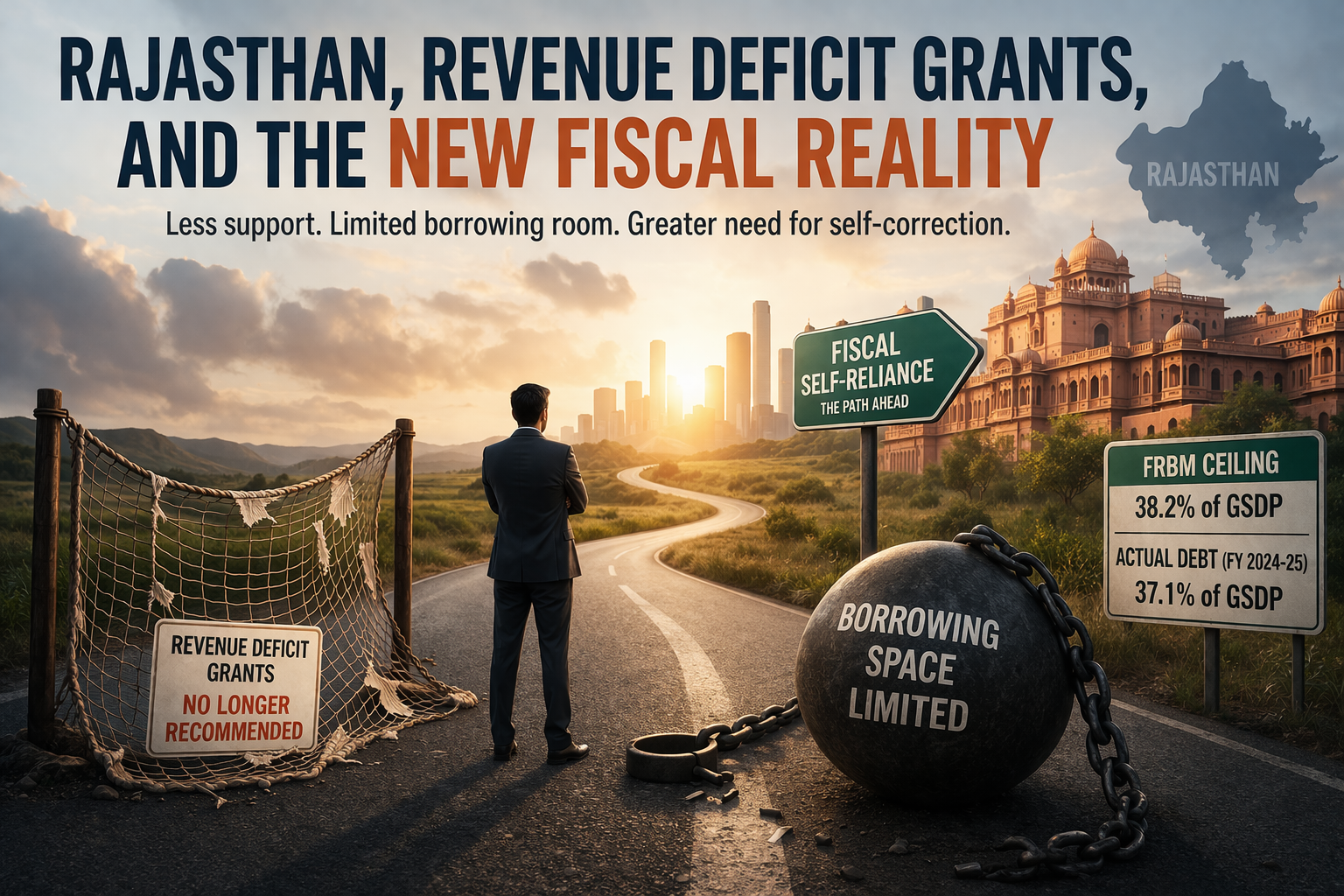
The commission has systematically discontinued open-ended post-devolution Revenue Deficit Grants, pivoting central transfers heavily toward Performance-Based Grants. This penalizes states that rely on central adjustments to finance daily operational deficits, forcing them to focus on the paper’s primary positive variable: expanding their Own Tax Revenue.
3. Clamping Down on Off-Budget Liabilities
To prevent states from window-dressing their balance sheets, the 16th Finance Commission formalizes strict rules regarding hidden debt. All off-budget borrowings incurred by states through public sector undertakings (PSUs) or special purpose vehicles must be fully adjusted against their Net Borrowing Ceilings under Article 293(3). This creates absolute accounting transparency, forcing hidden liabilities back onto the primary balance sheet and creating a true, verified baseline for macro-fiscal performance evaluation.
5. The New Era of Fiscal Federalism
The clear convergence between academic research, NITI Aayog’s diagnostic indexing, and active central policies reveals a significant shift in India’s macroeconomic philosophy. The era of treating deeply unequal states with rigid, identical budget rules is drawing to a close.
By protecting high-multiplier capital expenditure via SASCI, clamping down on off-budget window dressing, decoupling unique regional economies, and directly rewarding states for their nominal GSDP contributions through the 16th Finance Commission, India is successfully forging a new model of cooperative federalism. This balanced approach preserves macro-discipline at the top while safeguarding the structural growth engines of the states below.