Tag: public-finance

  • Why India Must Reclaim Fiscal Transparency

    Why India Must Reclaim Fiscal Transparency

    A government budget is far more than a dry recitation of revenues and outlays; it is the most significant contract of trust between a state and its people. For a democracy, this “public purse” is a covenant of accountability. When that covenant is honored through transparency, it anchors economic stability and invites public faith. However, when information is withheld, “information asymmetries” flourish—gaps where the state knows the truth of its finances while the public is left in the dark.These asymmetries are not merely academic concerns; they are the shadows where “hidden debts” grow. In the wake of the pandemic, unrecorded off-budget liabilities have surged to an estimated one trillion dollars globally. Without the sunlight of clear, timely data, financial markets cannot accurately price risk, and citizens cannot judge the true cost of policy choices. To measure the health of this fiscal sunlight, we turn to the Open Budget Survey (OBS), the world’s premier independent benchmark for fiscal governance.The latest OBS findings present a sobering narrative for New Delhi. While once on a path toward greater openness, India’s fiscal governance is currently undergoing a silent but significant shift—one that favors internal secrecy over public scrutiny. Through the pillars of transparency, participation, and oversight, the data reveals a nation retreating from global best practices, even as its peers demonstrate that institutionalized openness is the ultimate safeguard for a developing economy.

    The Great Transparency U-Turn

    India’s once-promising trajectory toward fiscal sunshine has been eclipsed by a return to the shadows of internal-only reporting. In the 2023 OBS report, India achieved a transparency score of 51 out of 100, reflecting a steady climb from earlier years. However, the 2025 report reveals a sharp regression to a score of 44. This decline marks a fundamental shift from providing “limited” information to providing “insufficient” information, effectively stifling informed public debate.The architecture of this decline is specific and deliberate. The backsliding is directly attributed to the government’s decision to reclassify two foundational documents—the Mid-Year Review and the Audit Report—as being for “internal use only.” By pulling these documents from the public domain, the executive has shuttered the windows through which the public could view mid-year fiscal health and adherence to spending rules. This regression endangers the very stability the state seeks to project.”Fiscal transparency is a fundamental prerequisite for financial stability. Without ready access to reliable, comprehensive, and timely information about the government’s true financial position, markets cannot properly evaluate the true costs and benefits of government activities.” —  Based on IMF and RBI premises.

    A Participation Score That Refuses to Move

    If transparency is the ability to see, participation is the ability to speak. On this front, India’s performance remains trapped in a state of “abysmal” stagnation. For both the 2023 and 2025 cycles, India’s public participation score has refused to budge from a dismal 6 out of 100.The breakdown of this score reveals a near-total exclusion of the public from the fiscal lifecycle. While the Ministry of Finance earns a modest score (20/100) for pre-budget consultations during the formulation stage, the door slams shut immediately thereafter. India recorded zeroes across the Approval, Implementation, and Audit stages. This means that once a budget proposal is finalized, there are no formal mechanisms for civil society or the public to testify before the Lok Sabha or contribute to the audit programs of the Comptroller and Auditor General. In the absence of these mechanisms, the budget becomes a monologue by the state rather than a dialogue with the people.

    The South Africa Benchmark: A Global Standard

    The argument that high-level fiscal transparency is a luxury of the developed world is dismantled by the example of South Africa. In the 2023 OBS, South Africa achieved a transparency score of 83 out of 100, ranking 4th globally among 125 nations. It is a study in how a developing economy can institutionalize openness to build international credibility.South Africa’s success is built on mechanisms India currently lacks. While India provides zeroes in audit and implementation participation, the South African National Treasury utilizes “e-consultations” to engage citizens directly. Furthermore, South Africa publishes an exceptionally comprehensive Pre-Budget Statement—a document India does not produce at all—which sets the stage for months of informed debate before the final figures are even tabled.

    The Missing Link: The Independent Fiscal Institution

    Perhaps the most critical differentiator is the presence of an Independent Fiscal Institution (IFI). South Africa’s Parliamentary Budget Office (PBO) is an independent, nonpartisan body whose independence is enshrined in law. Crucially, it reports directly to the legislature, not the executive, providing independent macroeconomic assessments and cost estimates for new policies.In India, the absence of an IFI creates a vacuum filled by “optimism bias”—the systemic tendency for budget projections to offer overly rosy forecasts of growth and revenue. Without an independent counter-weight, lawmakers are forced to accept executive figures at face value. Despite the urgent recommendations of the N.K. Singh (2017) and D.K. Srivastava (2018) committees to establish an independent fiscal council, the proposal remains shelved. This architectural void is the primary reason why Indian legislators often find themselves “flying blind” during the budget cycle.

    The Erosion of Legislative Watchdogs

    The decline in India’s transparency is mirrored by a weakening of its oversight institutions. Legislative oversight dropped from a score of 58 in 2023 to a mere 47 in 2025. The OBS explicitly flags “weak oversight during the planning stage,” noting that the Lok Sabha lacks the independent analysis and sufficient review time required to scrutinize the budget effectively.This erosion is a direct symptom of the missing IFI and the new culture of document secrecy. When the Mid-Year Review and Audit Reports are classified as internal, the “feedback loop” of governance is severed. Lawmakers cannot assess past performance to inform future spending, leading to a loss of what experts call “policy productivity.””Transparency in government accounts dramatically improves the ‘feedback loop’ of governance. When the true fiscal impacts of all policy initiatives are openly reflected, it enhances governmental accountability and ensures greater productivity in how public resources are utilized.” —  13th Finance Commission

    Beyond the Ledger: A Roadmap for Reform

    The path to restoring India’s fiscal standing requires more than a return to the status quo; it requires a structural evolution. First, the government must immediately reverse the classification of the Mid-Year Review and Audit Reports as “internal use” and restore their public availability. Second, India must move beyond its peers by  creating  a comprehensive Pre-Budget Statement to facilitate early-stage debate. Third, the Lok Sabha must institutionalize participation by allowing civil society to testify during budget hearings, following the model of South Africa’s e-consultations.Ultimately, the most vital reform is the establishment of a statutory, independent fiscal council. Without a nonpartisan body to harmonize statistics and check “optimism bias,” the executive’s control over the fiscal narrative remains unchecked.The current trajectory of fiscal secrecy is a risk to India’s long-term macroeconomic stability. As the global economy becomes increasingly sensitive to hidden liabilities and information gaps, we must ask: what is the personal cost of this growing fiscal blackout, and can India truly claim the mantle of a global economic leader while its public purse remains a private secret?

  • Beyond Deficit Targets: Re-Engineering India’s Sub-National Public Finance for Growth

    Beyond Deficit Targets: Re-Engineering India’s Sub-National Public Finance for Growth

    For over two decades, the core philosophy of macroeconomic management in India has been guided by a singular mandate: enforce fiscal discipline through strict numerical caps. Enacted through the Fiscal Responsibility and Budget Management (FRBM) Act of 2003 at the national level and subsequent Fiscal Responsibility Legislations (FRLs) across various states, these boundaries were designed to eliminate the “deficit bias” of governments, curb inflation, and secure long-term debt sustainability.


    However, an extensive empirical study by researchers Irsad, Mohd Yousuf Malik, and Syed Hasan Jafar evaluating India’s public finances from 1991 to 2022 exposes a deep structural flaw in this mechanism. The authors demonstrate an institutional “Decentralization Paradox”: while uniform fiscal rules successfully anchor stability at the national level, they create a restrictive trap that suppresses economic expansion at the sub-national (state) level.


    Fortunately, India’s public finance policy is undergoing a massive structural evolution. By connecting the historical baseline of that academic paper with NITI Aayog’s Fiscal Health Index (FHI) 2026, the legislative overhauls of the 16th Finance Commission, and the operational funding of the Central Government’s SASCI Scheme, we can map out how India is successfully shifting from rigid containment to a flexible, growth-centric framework.

    1. The Academic Diagnosis: The Simultaneous Model and the Capex Trap

    To untangle how legislative rules affect different tiers of government, the authors built a comprehensive Fiscal Performance Index (FPI) using Principal Component Analysis. This index aggregates six distinct variables to capture both revenue mobilization and expenditure quality:

    • Positive Indicators (Improve FPI): Own Tax Revenue to GDP/GSDP, Capital Expenditure to Total Expenditure, and Non-Tax Revenue to Total Revenue Receipts.
    • Negative Indicators (Degrade FPI): Fiscal Deficit to GDP/GSDP, Revenue Deficit to GDP/GSDP, and Interest Payments to Revenue Receipts.
      Because economic growth influences fiscal performance, and fiscal performance simultaneously impacts growth, standard statistical models face a “chicken-and-egg” dilemma of reverse causality. To resolve this, the authors deployed a Two-Stage Least Squares simultaneous equation framework. Instead of treating growth and fiscal health in isolation, the framework mathematically isolates the independent impact of legislative rules by controlling for external factors like the Terms of Trade, inflation, total outstanding debt liabilities, labor force expansion, and trade openness.

    The Core Findings:

    • The FPI Divergence (+0.14 vs. -0.04): The implementation of fiscal rules shows a significant positive coefficient of 0.14 with the national FPI, confirming that rules successfully consolidated central public finances. However, at the state level, it yielded a negative coefficient of -0.04, proving that rigid targets strip sub-national governments of the operational flexibility needed to handle local shocks.
    • The Expenditure Compression Trap: The model reveals that strict legislative rules trigger a stark growth penalty—-4.54 for national GDP and -5.09 for sub-national GSDP. When a state faces a revenue squeeze, it cannot easily reduce “committed expenditures” (salaries, pensions, and interest payments). To satisfy statutory deficit limits, it compresses the only flexible buffer available: discretionary Capital Expenditure.
    • The Multiplier Asymmetry (5.23): The framework shows that public investment holds an enormous growth coefficient of 5.23 at the state level, far higher than the 2.01 found at the center. Consequently, forcing states to trim infrastructure outlays directly penalizes long-term economic expansion.
    • Weak Growth Feedback Loops: The model proves that economic growth feeds back into fiscal health at a rate of 0.06 nationally, but a mere 0.01 at the state level. Sub-national governments cannot rely on national growth to clean up their balance sheets; their stability depends entirely on localized expenditure design.

    2. Mapping the Symptoms: NITI Aayog’s Fiscal Health Index 2026

    If the academic paper diagnoses a historical structural disease, NITI Aayog’s Fiscal Health Index (FHI) 2026 provides the active empirical proof. Tracking longitudinal trends over a clear decade-long baseline (FY 2014–15 to FY 2023–24), NITI Aayog organizes its ranking framework around Five Key Pillars that directly correlate with the variables identified by the academic paper.

    Structural Correlation: Academic FPI vs. NITI Aayog FHI 2026

    The Widening Sub-National Asymmetry

    The FHI 2026 results expose a massive divergence among major states, confirming the authors’ warnings about treating unequal states with uniform rules:

    • The Achievers: States like Odisha (which has topped the index for two consecutive years), Goa, and Jharkhand maintain excellent fiscal health. They consistently hold large capital outlays (around 4–5% of GSDP) and robust internal revenues, insulating them from expenditure compression.
    • The Committed Expenditure Trap: At the bottom, states like Punjab (ranking last with a score of 12.4 out of 100), West Bengal, and Kerala face severe fiscal distress. Their committed expenditures (salaries, pensions, and subsidies) absorb an overwhelming 50–60% of their total revenue receipts, leaving virtually zero fiscal space for developmental capex.

    Abandoning Uniformity: The North-East Decoupling

    In a direct implementation of the paper’s primary recommendation to abandon “one-size-fits-all” templates, NITI Aayog’s 2026 index completely decoupled the 10 North-Eastern and Himalayan states from the major states, ranking them on an independent grid. This officially recognizes that unique geographical isolation, sparse populations, and high service delivery costs require distinct, calibrated fiscal baselines.

    3. The Operational Antidote: The GoI’s SASCI Scheme

    To break the “capex compression trap” highlighted in the paper, the Central Government deployed a powerful operational counter-measure: the Scheme for Special Assistance to States for Capital Investment (SASCI).
    First rolled out by the Ministry of Finance in October 2020 during the pandemic revenue shock, SASCI acts as a countercyclical safety valve. It extends 50-year interest-free loans to state governments that are strictly earmarked for capital asset creation.

    How SASCI Resolves the Financial Dilemma:

    • Over and Above Limits: SASCI funds are provided completely outside a state’s normal Net Borrowing Ceiling. When local revenues contract, states can draw down these funds to sustain their core infrastructure pipeline without breaching their local FRL limits.
    • Excluding Revenue Leakage: The scheme explicitly bars states from utilizing these funds to bridge revenue deficits, cover interest burdens, or pay administrative salaries.
    • Targeting Structural Asymmetry: SASCI incorporates dedicated windows like the “Pride of Hills” allocations (safeguarding capital budgets for Himalayan states) and “Unity Malls” funding.
    • Upgrading Digital Governance: Reflecting the paper’s demand for deep public finance IT improvements, Part-IV of the SASCI scheme links funding to the mandatory integration of state treasuries with the Central Public Financial Management System (PFMS), establishing automated, end-to-end digital tracking of asset creation.

    4. The Legislative Overhaul: The 16th Finance Commission (2026–2031)

    While SASCI injects active capital into state budgets, the 16th Finance Commission framework provides the long-term legislative architecture designed to change sub-national incentives for the 2026–2031 allocation period.

    1. Re-Engineering the Devolution Loop: The 10% GDP Weight

    The 16th Finance Commission maintained the vertical devolution share to states at 41%, but introduced a major modification to the horizontal distribution criteria: a 10% weight for a state’s direct contribution to nominal GDP, replacing the older, generic “tax effort” metric. This directly addresses the paper’s finding that growth feedback loops are structurally weak for states (0.01). By rewarding GSDP expansion, the commission ensures that states that drive local economic engines are automatically compensated with a larger share of untied central taxes.

    2. Eliminating the Revenue Deficit Crutch

    The commission has systematically discontinued open-ended post-devolution Revenue Deficit Grants, pivoting central transfers heavily toward Performance-Based Grants. This penalizes states that rely on central adjustments to finance daily operational deficits, forcing them to focus on the paper’s primary positive variable: expanding their Own Tax Revenue.

    3. Clamping Down on Off-Budget Liabilities

    To prevent states from window-dressing their balance sheets, the 16th Finance Commission formalizes strict rules regarding hidden debt. All off-budget borrowings incurred by states through public sector undertakings (PSUs) or special purpose vehicles must be fully adjusted against their Net Borrowing Ceilings under Article 293(3). This creates absolute accounting transparency, forcing hidden liabilities back onto the primary balance sheet and creating a true, verified baseline for macro-fiscal performance evaluation.

    5. The New Era of Fiscal Federalism

    The clear convergence between academic research, NITI Aayog’s diagnostic indexing, and active central policies reveals a significant shift in India’s macroeconomic philosophy. The era of treating deeply unequal states with rigid, identical budget rules is drawing to a close.
    By protecting high-multiplier capital expenditure via SASCI, clamping down on off-budget window dressing, decoupling unique regional economies, and directly rewarding states for their nominal GSDP contributions through the 16th Finance Commission, India is successfully forging a new model of cooperative federalism. This balanced approach preserves macro-discipline at the top while safeguarding the structural growth engines of the states below.

  • Toward More Informed Practitioners in Government

    Why government needs more than routine competence

    One thing I have increasingly noticed in public service is this: meaningful conversations about the larger direction of our domains are surprisingly rare.

    Most practitioners are comfortable discussing a file. We can examine a rule position, debate a procedural issue, clarify an approval path, or draft a response on a pending case. That part of professional life is familiar. It is where most of us operate with confidence.

    But the moment the discussion moves beyond the immediate file and toward the larger direction of the sector, the conversation often becomes much thinner.

    How often do government administrators seriously discuss whether existing policy design is actually likely to produce better outcomes this year? How often do they read implementation frameworks, field studies, or policy papers that test whether current practice is working? How many finance personnel regularly engage with questions of budgeting quality, fiscal design, procurement reform, or better utilisation of public money?

    In my experience, such conversations are rare.

    That absence matters more than it appears.

    The file-centric culture of practice

    Over time, professional life becomes narrowly file-centric. One learns how to process work, but not always how to understand the larger system behind that work.

    A practitioner may become efficient, careful, and procedurally sound, yet remain underexposed to the wider ideas, debates, and frameworks that should improve judgment. In such an environment, disposal improves faster than interpretation. People become good at moving work, but not necessarily at questioning whether the system is producing better outcomes.

    This is not a criticism of practitioners as individuals. In most cases, the issue is structural.

    The system rewards timely handling of work. It does not as visibly reward deeper reading, reflection, or conceptual clarity. Daily office responsibilities consume time. Social media consumes attention. Serious reading becomes a personal choice rather than an institutional expectation.

    As a result, many practitioners remain highly experienced, but not always deeply informed in the evolving sense of the term.

    Why intellectual stagnation is a systemic problem

    The problem is often misunderstood as one of personal discipline alone. It is more than that.

    Government systems are designed to ensure continuity, compliance, and administrative order. Naturally, they create routines. But when routine becomes the dominant professional condition, it can slowly reduce curiosity. The mind adjusts to immediate tasks, recurring formats, and familiar workflows. The incentive is to be safe, timely, and procedurally correct.

    There is value in that. Public administration cannot function without procedural reliability.

    But if the system only values safe disposal and does not create any meaningful rewards for deeper understanding, then intellectual stagnation becomes a rational outcome. Officers may continue to perform their assigned roles well, but their capacity to interpret new challenges, absorb new ideas, and contribute to systemic improvement weakens over time.

    That is a loss not only for individuals, but for institutions.

    Why governments increasingly turn to consultants

    This may also explain why governments increasingly outsource thinking-heavy, design-heavy, and reform-oriented tasks to private consultants.

    This is not necessarily because consultants are inherently more capable than government practitioners. In many cases, government officers possess stronger contextual understanding, legal memory, field exposure, and administrative realism. They understand the lived constraints of departments, field formations, and public systems in ways outsiders often do not.

    Yet consultants usually work in a clearer incentive structure.

    If someone in a consulting firm handles a difficult assignment well, that person is more likely to be trusted with more important work. Capability gets noticed. Better effort has clearer rewards. Reading, analysis, presentation, and structured problem-solving are part of how value is judged.

    In government, that link is often much weaker.

    An officer may read more, think more, reflect more, and become significantly better informed, yet the system may not meaningfully distinguish that officer from someone who merely disposes of routine work on time. Over time, this weakens the incentive for intellectual effort within the system itself.

    What is not cultivated internally is eventually purchased externally.

    The missing layer: knowledge-producing state institutions

    But the issue goes beyond individual incentives.

    At the state level, we rarely have strong institutions that continuously produce useful working papers, policy notes, implementation studies, or practical domain analysis for practitioners. Where such institutions exist, many are primarily engaged in structured departmental training, especially for new entrants.

    Serving officers may occasionally receive a few sessions on recent developments in the department. That may be informative. But it is not the same as creating a living knowledge ecosystem.

    Practitioners do not only need training. They need intellectual support.

    They need institutions that regularly produce grounded, readable, practice-oriented material on administration, finance, budgeting, procurement, implementation, monitoring, and reform. They need short papers that explain new developments in usable form. They need implementation reviews that honestly assess why certain schemes, processes, or reforms are underperforming. They need comparative notes that show what other states, sectors, or countries are doing differently.

    Without such institutions, professional learning remains thin and episodic.

    Why this weakens governance over time

    In the absence of strong incentives and strong knowledge institutions, the system becomes doubly weak.

    Internally, practitioners remain trapped in routine. Externally, governments become dependent on private consultants for the very thinking capacity they failed to build within.

    That creates a deeper institutional problem. The state may continue to retain authority, but it gradually loses some of its in-house ability to diagnose its own problems, frame alternatives, or challenge external advice with confidence. When that happens, outsourcing is no longer just about technical support. It becomes outsourcing of institutional thinking.

    This is not sustainable if governments want stronger internal capacity over the long term.

    A system cannot become wiser merely by processing more files. It becomes wiser when its practitioners are able to connect rules with purpose, expenditure with outcomes, and administrative action with public value.

    What more informed practice would look like

    A more informed practitioner is not necessarily someone who reads everything or speaks in abstract language. It is someone who develops the habit of stepping back from immediate work and asking larger questions.

    Why does this rule exist in its present form?

    What problem was it originally meant to solve?

    Why are outcomes weak despite repeated expenditure?

    Where is implementation failing: in design, incentives, monitoring, capacity, coordination, or political prioritisation?

    What are better systems doing differently?

    What can be adapted, and what cannot?

    These are not academic questions. They are practical questions. In many cases, they are exactly the questions that separate routine administration from meaningful improvement.

    Better governance requires more practitioners who can think in this way.

    What needs to change

    If governments want more informed practitioners, three things matter.

    First, incentives must improve. Systems do not have to become perfectly meritocratic overnight, but they must begin to visibly value intellectual effort, problem-solving, and domain understanding.

    Second, professional spaces must improve. Practitioners need more opportunities for serious domain-level discussion, not just file-level exchange.

    Third, institutions must improve. States need knowledge-producing institutions that do more than deliver structured training. They should produce practical, credible, and accessible analysis that practitioners can actually use.

    Only then can professional life move beyond mere procedural familiarity.

    Conclusion

    A healthy governance system needs more than competent handling of today’s file.

    It needs practitioners who can understand the larger system within which that file exists. It needs officials who are not merely efficient within process, but thoughtful about the purpose, limitations, and consequences of that process.

    At present, that intellectual layer is often too weak. Practitioners are busy, but not always institutionally supported to become more informed. Conversations remain narrow. Incentives remain shallow. Knowledge institutions remain underdeveloped. And the state increasingly depends on external actors to supply capacities it should have been nurturing within its own systems.

    Better governance will not come only from more rules, more reviews, or more outsourcing.

    It will also come from cultivating more informed practitioners.

    That requires a genuine knowledge culture inside government: one that values reading, reflection, discussion, and applied learning as part of professional life itself.

    Only then can routine experience mature into judgment.

    And only then can judgment begin to improve governance.

  • A Shrinking Slice of the Pie: Why Rajasthan Must Act Fast on Urban Revenues

    A Shrinking Slice of the Pie: Why Rajasthan Must Act Fast on Urban Revenues

    The financial health of India’s cities is increasingly dependent on their ability to generate Own Source Revenue (OSR), which consists of taxes and non-tax revenues that Urban Local Governments (ULGs) have the legal authority to levy and collect. For the Urban Local Bodies (ULBs) of Rajasthan, navigating municipal finance presents a unique paradox. On one hand, the state boasts some of the most progressive legal and valuation frameworks in the country. On the other, it struggles with a highly depressed tax base heavily influenced by massive tax exemptions and broader demographic factors.

    However, recent shifts in national funding policies—specifically the mandate of the 16th Finance Commission (FC-16)—make it clear that Rajasthan can no longer afford to ignore its OSR deficits, regardless of its urbanization levels.

    The Urbanisation Hurdle: A Structural Disadvantage

    At a macroeconomic level, a city’s ability to mobilize OSR is heavily tied to its degree of urbanization and economic base. Rajasthan is officially categorized as a “less urbanised large state,” meaning it has an urban population of less than 30% alongside a total population exceeding 35 million.

    Data shows a direct, positive correlation between the level of urbanization and a municipality’s ability to generate its own revenues. For instance, metropolitan ULGs in more urbanized large states collect nearly 3 times the OSR of metros in smaller urbanized states, and a staggering 10 times that of metros in less urbanized states like Rajasthan . Consequently, Rajasthan’s ULBs inherently face a lower baseline revenue generation potential and structurally require more support for both operational and capital expenditures.

    Self-Inflicted Wounds: The Cost of Massive Exemptions

    While low urbanization naturally limits revenue buoyancy, Rajasthan severely restricts its own potential through highly generous tax policies. A major constraint on the state’s OSR mobilization is its policy of granting unusually large size-based exemptions for property taxes.

    The state currently exempts all residential properties below 2,700 square feet and all commercial properties below 900 square feet. This creates a highly depressed tax base, severely limiting revenue potential. To put this in perspective, jurisdictions under the Mumbai Municipal Corporation Act only exempt residential properties below 500 square feet. Because of these massive exemptions, property tax contributes less than 10% of the total OSR for Rajasthan’s ULBs, and the state’s ULB OSR as a percentage of its non-primary Gross State Value Added (GSVA) sits at a mere 0.18%, lagging far behind leading states like Maharashtra (1.40%) or Gujarat (0.84%).

    The 16th Finance Commission: A Wake-Up Call

    The urgency for Rajasthan to overhaul its municipal finances stems directly from the 16th Finance Commission (FC-16), which has explicitly recognised urbanisation characteristics and made accelerating urban growth a central focus of its grants-in-aid. To incentivize speedier urbanisation, FC-16 shifted the macro-allocation of total local body grants between Rural Local Bodies (RLBs) and ULBs to a 60:40 ratio.

    However, the methodological changes introduced by FC-16 structurally disadvantage Rajasthan.

    Under the new FC-16 formula, Rajasthan’s inter se share for the ULB grant pool is fixed at 5.21%. The shift from a formula that rewarded geographical size to one that rewards urban population size and municipal revenue generation strongly indicates that Rajasthan has lost its previous structural advantages in securing urban grants.

    Silver Linings: Progressive Frameworks to Build Upon

    Despite these formidable challenges, Rajasthan presents a mixed picture because it has already implemented critical, politically difficult reforms that many other states lack :

    1. Capital Value (CV) Method for Property Tax: As of 2025, Rajasthan is one of only seven states in India to transition to the Capital Value method for levying property tax. This superior methodology ensures that property taxes are a buoyant source of revenue because it links the taxable value directly to state-notified guidance values or circle rates, reflecting actual market rates.

    2. Legal Mandates for Water Cost Recovery: Rajasthan is one of only six states that have successfully implemented legal frameworks explicitly linking the setting of water tariffs to Operation and Maintenance (O&M) cost recovery. This protects the state from the severe under-pricing that plagues the 13 other states lacking such mandates.

    Pathways Forward: How Rajasthan Can Augment OSR

    To survive the fiscal shift brought by the 16th Finance Commission and ensure fiscal sustainability, Rajasthan must leverage its progressive frameworks and focus on specific levers to augment OSR:

    • Roll Back Size-Based Exemptions: The most immediate fix is expanding the tax net by significantly lowering the massive exemption thresholds for residential and commercial properties, allowing the excellent CV valuation method to actually capture revenue.
    • Enforce the Water Tariff Frameworks: Rajasthan must actively use its existing legal mechanisms to ensure water tariffs are formulaically linked to O&M costs, addressing the historical under-pricing of utility services.
    • Monetize Municipal Assets: ULBs should create comprehensive, geo-tagged digital asset inventories of municipal lands and buildings, and establish robust legal frameworks to link rental income to market values.
    • Leverage Land Value Capture (LVC): By integrating urban planning with finance, Rajasthan’s ULBs can tap into financial windfalls generated by public infrastructure projects through development charges and betterment levies.

    Conclusion

    Rajasthan cannot change its current urbanization levels overnight. However, it has total control over its municipal tax policies. By removing archaic property tax exemptions and fully utilizing its modern valuation and tariff frameworks, Rajasthan can overcome its structural disadvantages, improve its OSR buoyancy, and secure its rightful share of national urban development funding.

  • When the Safety Net Is Gone and Borrowing Space Is Nearly Exhausted: A Fiscal Question for Rajasthan

    When the Safety Net Is Gone and Borrowing Space Is Nearly Exhausted: A Fiscal Question for Rajasthan

    Public finance often looks technical from a distance. But sometimes, one policy shift captures a much larger story.

    A simple way to understand the present moment is this: what happens when a government can no longer rely on a fiscal safety net, while at the same time its room to borrow is already becoming narrow?

    That is the broader question emerging from the changing treatment of Revenue Deficit Grants in the Finance Commission framework, especially in the context of Rajasthan.

    The 15th Finance Commission: A Significant Revenue Deficit Cushion

    Under the 15th Finance Commission, Rajasthan was recommended total grants-in-aid of ₹59,374 crore for the award period 2021–26. Out of this – ₹14,740 crore was recommended as Revenue Deficit Grant This was about 24.83% of the total grant-in-aid The full recommended amount was released.

    This is an important point. Revenue Deficit Grant was not a minor component. It was a substantial part of the overall support package. In effect, it acted as a cushion for the State’s revenue-side imbalance.

    The 16th Finance Commission: A Clear Policy Shift

    For the 16th Finance Commission award period, the total grant-in-aid recommended to Rajasthan is stated to be ₹53,357.75 crore. But the more notable shift is this- No Revenue Deficit Grants have been recommended for the award period of 16th FC.

    That is not merely a change in one line item. It suggests a deeper shift in fiscal philosophy.

    The idea appears to be that States should increasingly manage their own revenue gaps through internal correction rather than through recurring external compensation.

    Why This Shift Matters – Revenue Deficit Grants were meant to support States where revenue expenditure exceeded revenue receipts. When such support is available, it provides breathing room.

    When that support is withdrawn, the expectation changes.The burden then shifts more directly toward: improving tax effort, increasing tax efficiency, rationalising expenditure, containing revenue spending, strengthening internal fiscal discipline

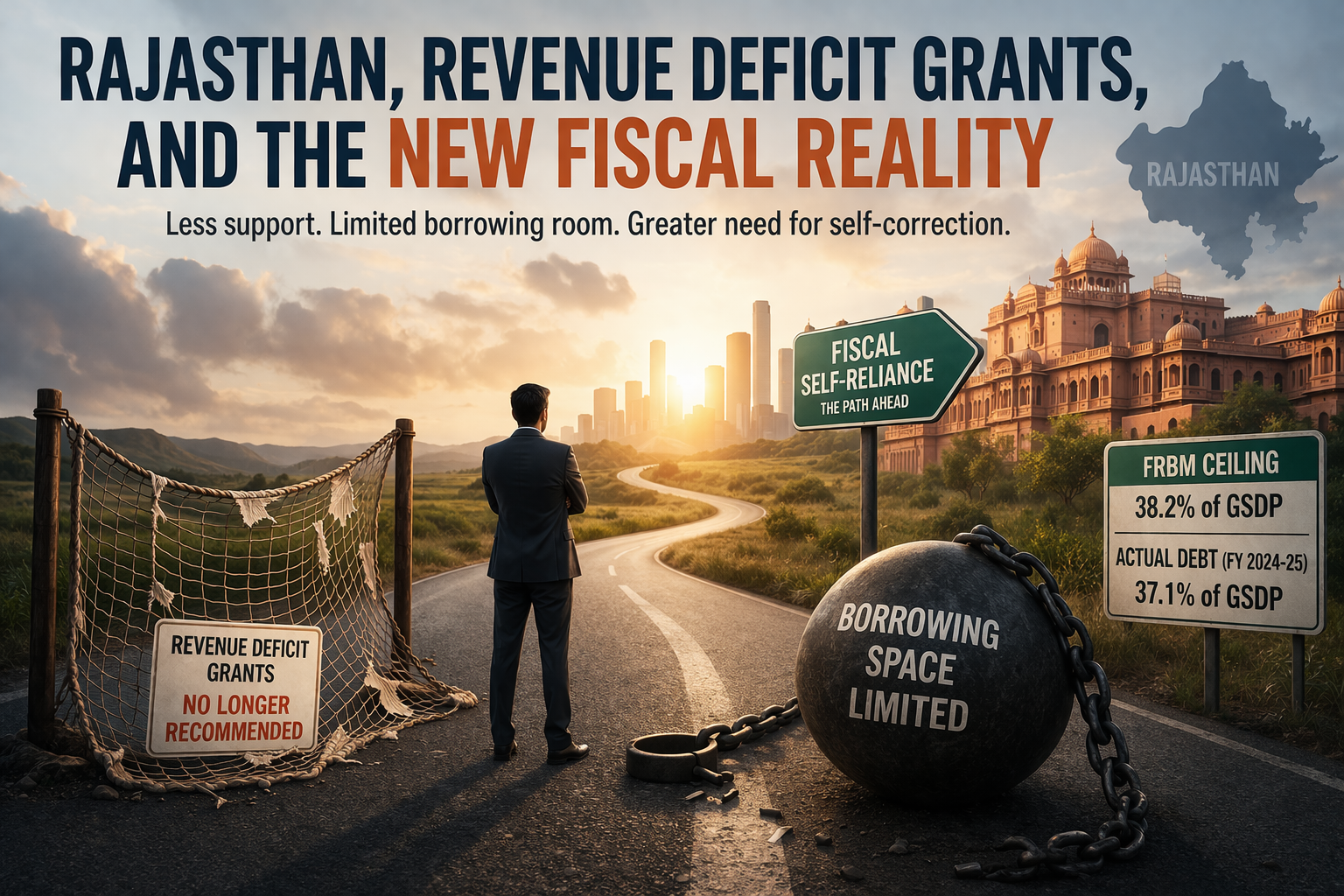
    In other words, the framework moves from supporting the deficit to forcing correction of the deficit. Rajasthan’s fiscal capacity faces a double pressure. This transition becomes more significant when seen alongside Rajasthan’s debt position.As stated: the FRBM ceiling for debt is 38.2% of GSDP as per the Finance Accounts for FY 2024–25, the State’s actual debt is already accumulated at 37.1% of GSDP.

    This creates a real double pressure on fiscal capacity. On one side: Revenue Deficit Grant support is no longer available. On the other side: remaining borrowing space is limited. That means the State cannot comfortably depend either on a revenue-gap grant cushion or on large additional debt space. Fiscal adjustment, therefore, has to come increasingly from within the system.

    A larger change in fiscal federalism seen together- these developments indicate a broader transition in India’s fiscal federalism. Earlier approach supported States through revenue gap funding but emerging approach- expect States to correct deficits through their own fiscal management. This reflects a move away from compensating persistent imbalances and toward encouraging structural correction. Whether this shift will strengthen long-term fiscal resilience or deepen short-term stress is a separate debate. But the direction of policy is becoming clearer.

    The Core Question Ahead

    For Rajasthan, this is not just an abstract policy matter. It has direct implications for:- budget management, expenditure prioritisation, subsidy rationalisation, tax administration, fiscal sustainability.

    The real question is no longer only how much support a State receives. The more important question is this:

    How should a State respond when grant support reduces, borrowing headroom narrows, and fiscal adjustment has to come increasingly from within?


    Reduced fiscal cushion. Limited borrowing room. Greater pressure for self-correction.

    That is where the next phase of the public finance debate is heading.